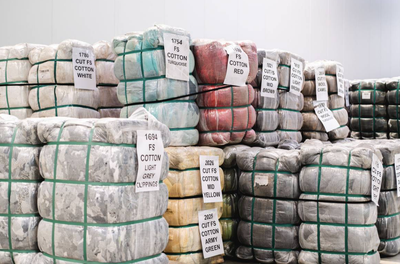

Fashion has spent years looking for a technological solution to its waste problem. Textile-to-textile recycling, automated sorting and new fibre technologies are increasingly presented as key pieces of the circular fashion puzzle. But as investment in recycling grows, a more fundamental question is becoming difficult to avoid: can fashion really recycle its way out of overproduction?
The answer, according to recent research and industry analysis, is increasingly clear: not on its own.
A new report from the Boston Consulting Group and ReHubs Alliance, published in March, found that Europe generated around 25 kilograms of post-consumer textile waste per person in 2025. While textile-to-textile recycling could help return discarded clothing into the production system, the report found that establishing a viable European recycling system requires substantial investment and is currently not considered profitable without additional support.
The problem begins long before a garment reaches a recycling facility. Europe’s textile consumption has continued to increase. According to the European Environment Agency, EU textile consumption rose from an average of 17 kilograms per person in 2019 to 19 kilograms in 2022. In the same year, EU countries generated approximately 6.94 million tonnes of textile waste, equivalent to 16 kilograms per person.
Only a small proportion of that waste is currently captured through separate collection systems. In 2022, the EU’s average textile waste capture rate was just under 15%, meaning roughly 85% of household textile waste was not separately collected and instead entered mixed household waste streams. Recycling technology cannot process clothing that never reaches a recycler.
There is another problem: even clothing that is collected is not necessarily suitable for textile-to-textile recycling. Garments may contain blends of different fibres, dyes, finishes, trims or other components that make them difficult or expensive to separate. The quality and condition of discarded textiles can also vary considerably. This means that simply increasing recycling capacity will not automatically create a circular fashion system.
The latest European research increasingly points towards a system-level problem rather than a technology problem. The European Commission highlighted nine EU-funded research projects in July focused on improving textile sorting, recycling, traceability and circular production. These include technologies designed to improve fibre recovery and pilot projects testing circular textile value chains.
These developments are significant. Better sorting and recycling technology could allow more discarded garments to become usable raw material, reducing dependence on virgin resources.

But recycling primarily addresses what happens after a garment has been produced and used. It does not address how many garments are being produced in the first place.
That distinction matters. The European Environment Agency estimates that between 4% and 9% of textile products placed on the European market are destroyed before they are ever used, equivalent to between 264,000 and 594,000 tonnes every year. The agency links this waste to overproduction of particular styles, colours, sizes and products.
A garment that is never sold does not need recycling technology. It needed not to be produced in the first place. This is where the industry's growing focus on circularity can become complicated. Resale, repair and recycling can all extend the useful life of textiles and reduce demand for virgin resources. But if these solutions are used to justify continually increasing production, their environmental benefits can be undermined by the sheer volume of new clothing entering the market.
The European Environment Agency has found that higher consumption has already partly offset improvements in production efficiency. Between 2010 and 2022, EU textile consumption increased by 15%, while some environmental pressures fell. However, the agency notes that these efficiency gains have slowed and emphasises that addressing overconsumption and fast fashion remains essential.

The challenge, then, is not to choose between recycling and reducing production. Fashion needs both. A genuinely circular system would keep garments in use for as long as possible through durability, repair, resale and reuse before recycling becomes necessary. Recycling would then recover materials from products that have genuinely reached the end of their useful lives rather than becoming a justification for producing more disposable clothing.
Regulation is beginning to reflect this broader approach. The EU’s strategy for sustainable and circular textiles explicitly aims to move away from fast fashion towards longer-lasting products, increased reuse and recycling. New legislation is also placing greater emphasis on product durability, repairability and waste prevention.
The industry therefore faces a choice. It can continue to invest heavily in technologies capable of dealing with an ever-growing mountain of discarded clothing. Or it can use those technologies as one part of a much larger transformation that also tackles how much fashion is produced, how long garments are used and what happens to them afterwards.
Recycling is undoubtedly part of fashion’s circular future. But it cannot make overproduction disappear. The most circular garment may still be the one that was not replaced, the one that was repaired, or the one that stayed in someone’s wardrobe for another five years. For an industry built around selling more clothes, that may be the hardest part of becoming truly circular.